" height="92.50112883894141px" id="Pmu43BlfI" width="92.49875410504055px"/><path d="M 0 0 L 34.11 34.11 Z" fill="rgb(255, 255, 255)" height="34.11px" id="L_WVVEFP6" transform="translate(29 29.5)" width="34.11000000000001px"/><path d="M 0 0 L 34.11 34.11" fill="transparent" height="34.11px" id="VnhBHmLaw" stroke-dasharray="" stroke-linecap="round" stroke-linejoin="round" stroke-width="2.753" stroke="rgb(255, 255, 255)" transform="translate(29 29.5)" width="34.11000000000001px"/><path d="M 4.996 5.685 L 5.036 5.685 L 12.1 12.748 C 10.769 14.231 10.018 16.145 9.986 18.138 C 9.933 21.553 11.984 24.65 15.15 25.933 C 18.077 27.117 21.423 26.531 23.773 24.423 L 32.053 32.703 C 31.879 32.722 31.703 32.733 31.526 32.733 L 4.996 32.733 C 2.237 32.732 0.001 30.496 0 27.737 L 0 10.682 C 0 7.923 2.237 5.686 4.996 5.685 Z M 14.603 0 L 21.919 0 C 23.589 0 25.148 0.834 26.075 2.223 L 27.614 4.535 C 28.062 5.207 28.798 5.63 29.604 5.68 L 29.764 5.685 L 31.526 5.685 C 32.851 5.685 34.122 6.212 35.059 7.149 C 35.996 8.086 36.522 9.357 36.522 10.682 L 36.522 24.505 L 12.489 0.472 C 13.151 0.162 13.872 0.001 14.603 0 Z M 20.105 20.755 C 18.871 21.674 17.15 21.547 16.064 20.458 C 14.977 19.371 14.85 17.651 15.766 16.416 L 20.105 20.756 Z" fill="rgb(255, 255, 255)" height="32.73299994277955px" id="xjQ7lng5u" stroke-dasharray="" stroke-linecap="butt" stroke-linejoin="miter" stroke-miterlimit="10" stroke-width="1.377" stroke="rgb(255, 255, 255)" transform="translate(28 30)" width="36.52200042065968px"/></g></svg>)
SafeBook
Timeline
Autumn 2025
10 weeks
My Role
UX Design
Skills
User Research
User-Centered Design
Iterative Design
Rapid Prototyping
With
Lina (Jiayu) Wang
Ruohan Li
My Impact
From concept to completion, as a UX Designer, I designed and created a interactive web prototype and a mobile prototype (through Bolt) based on exploratory research and data gathered from previous iteration user tests I conducted.
This project was created as part of the UW HCDE MS program.
Redesigning a privacy-oriented travel booking process.
Overview
Travelers are anxious and uncertain about invasive surveillance in lodgings and time-efficient safety measures.
Travelers are relatively unaware of preventative tools and privacy laws differ geographically leading to confusion about their defensive rights. As a team, we explore how travelers could regain confidence in their safety.
My Design Proposal
a low interruption tool to reduce travel anxiety by augmenting existing booking flows with informed safety choices.
Highlights
Streamlined safety throughout the travel process —
for both cautious and casual travelers.
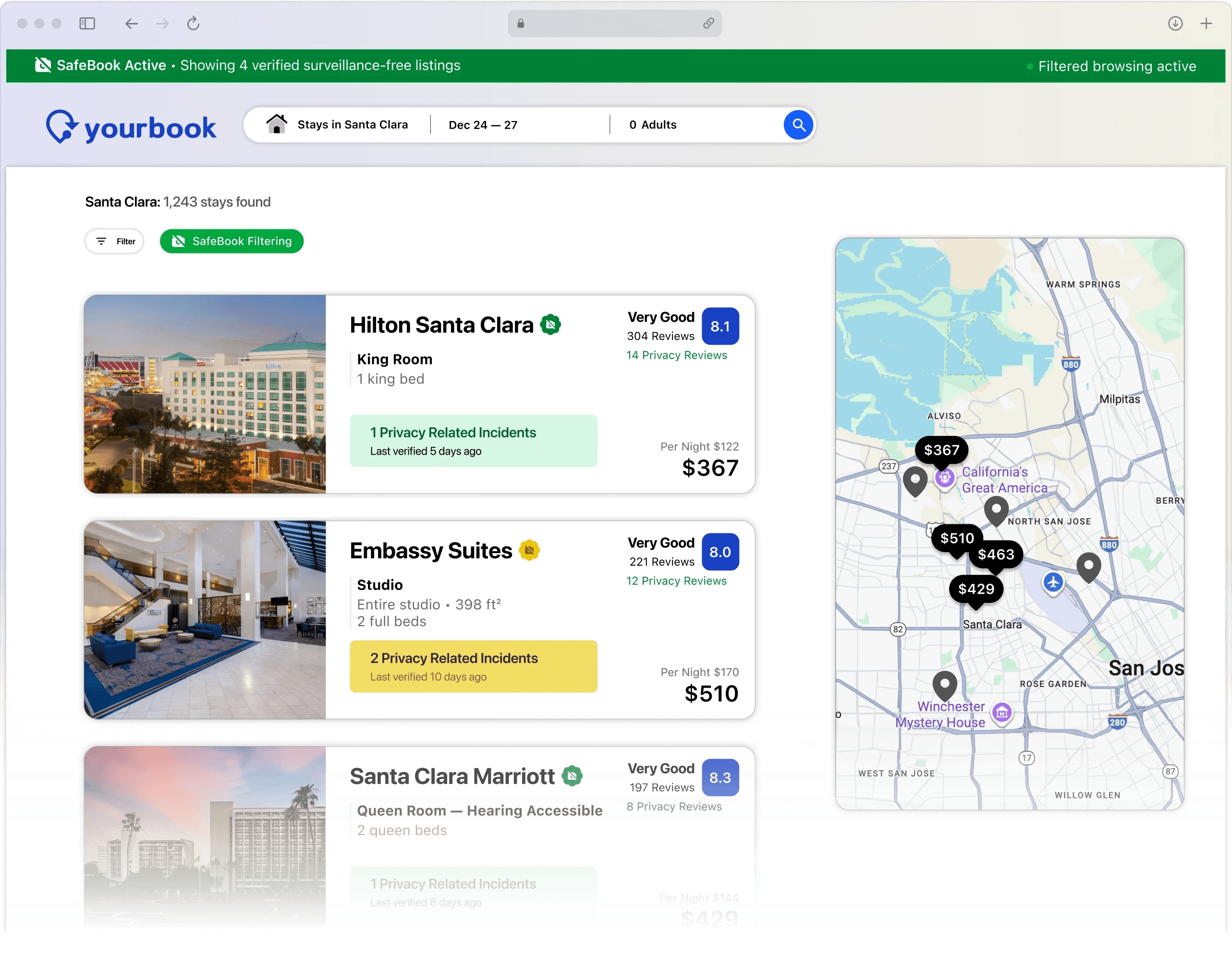
By integrating aggregated privacy violation reports and inspections onto property cards, users can easily take preventative measures for their safety at a glance.
Seamless integration into the existing booking experience.
Privacy Inspection Reports
Distinct signaling for quick browsing with easily discovered reports for the more cautious traveler.
Safety Risk Levels
No Risk
Low Risk
High Risk
Tags & Filters for Visibility
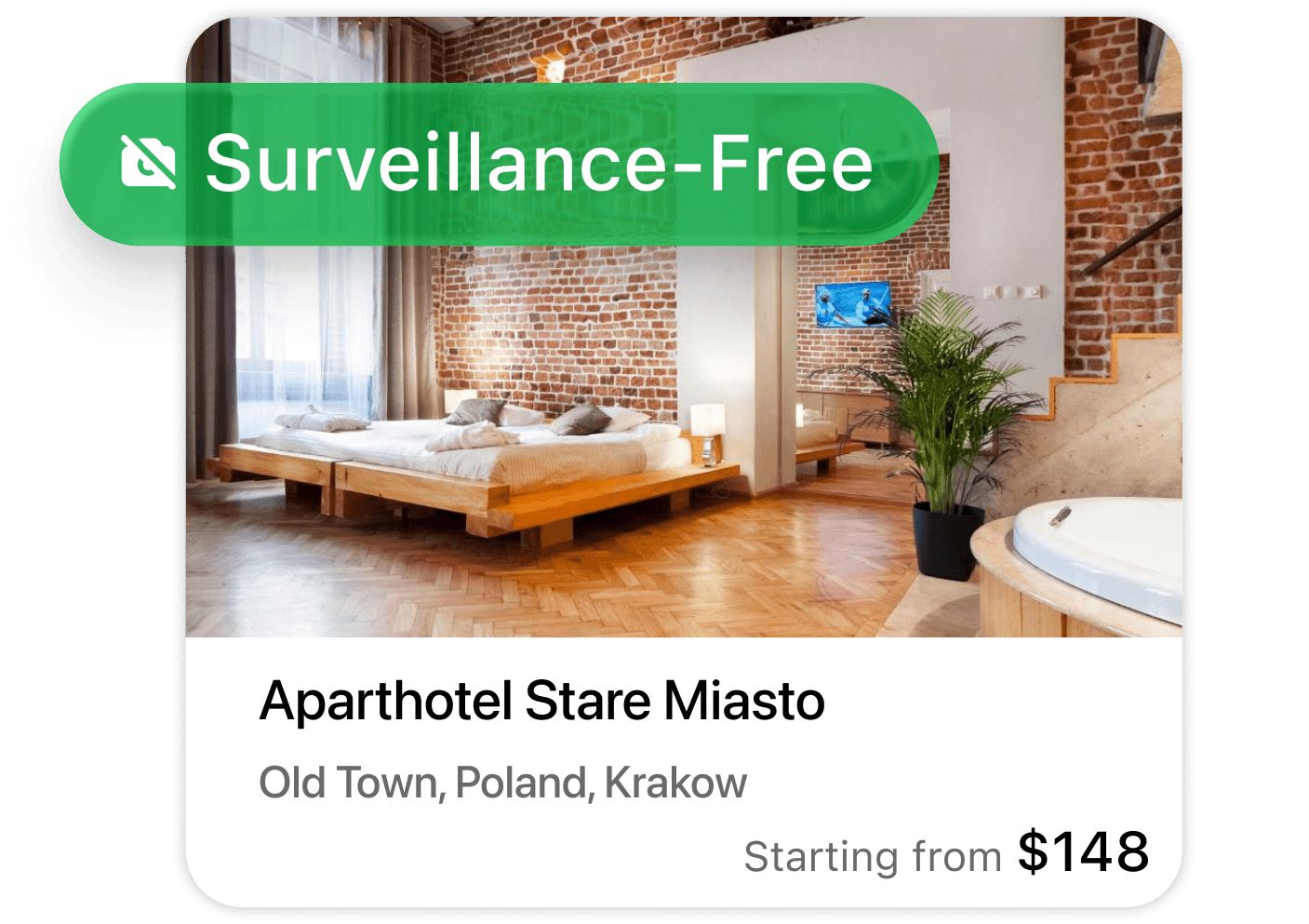
Counterpart Mobile App
For on-the-go convenience at a new destination.
Created in 3 hours with an AI-powered builder.
Context
Improvements in image capturing technology make small cameras difficult to detect by the naked-eye. As these technologies become more accessible, there has been a rise in privacy violations where individual's likeness is captured without consent, particularly in private spaces such as restroom stalls, changing rooms, and travel stays.
With increasingly discrete cameras, individuals experience anxiety about their privacy and digital image.
User Research
Focusing on invasive image capture, we explored areas where we could …
protect user consent and data privacy.
The Breakdown

Research Methods
Exploration
To better understand our target users and familiarize ourselves with current digital surveilance technologies we used 4 complementary methods:
Lit Review
21+ news reports and academic journals
Surveys
12+ responses
Ethnographic Studies
4+ first-hand accounts
User Interviews
6 semi-structured
Insights
Synthesis
Our research led us to a few key areas:
Privacy laws vary by location making travelers uncertain about their rights.
Surveillance alters behavior when individuals are aware.
Widespread surveillance has fostered "passive trust in invisibility", where individual's assume privacy when monitoring is not visible.
Surveillance is accepted as security measures in highly public spaces (e.g. lobbies, stores, etc.) .
Surveillance is perceived as invasive in deemed private spaces(e.g. locker rooms, bedrooms, closets)
Audio surveillance in hybrid spaces (public/private) is perceived negatively.
Travelers book stays based on Convenience, Cleanliness, Crowd-proofing, and Consensus.
Travelers and travel properties build trust through online feedback and visible upkeep over surveillance devices.
Low-effort, time-efficient solutions easily integrated into existing travel habits are user preferred.
With this context in mind, we landed on a core question:
How might we
boost traveler confidence in their privacy throughout the travel process (before, during, after their stay) to empower them to act decisively if their privacy is violated?
Defining Scope
Focus
After understanding our users, we were able to identify our design goals, key stakeholders, and target personas.
Setting Relevant Goals

The Design Should …
Be Built on User Consent
Consent should be easily understood and can be easily withdrawn.
Be Transparent
Design is transparent, simple, and straightforward about functions: no unnecessary features or steps, no extra knowledge required.
Not Disturb User Flow
Design can be easily integrated into travelers' original travel routines.
Identifying Key Stakeholders
Travelers
Hosts
Booking Platforms
Target Personas
Some quotes from our user interviews:
Designs & Iterations
Exploring different possibilities.
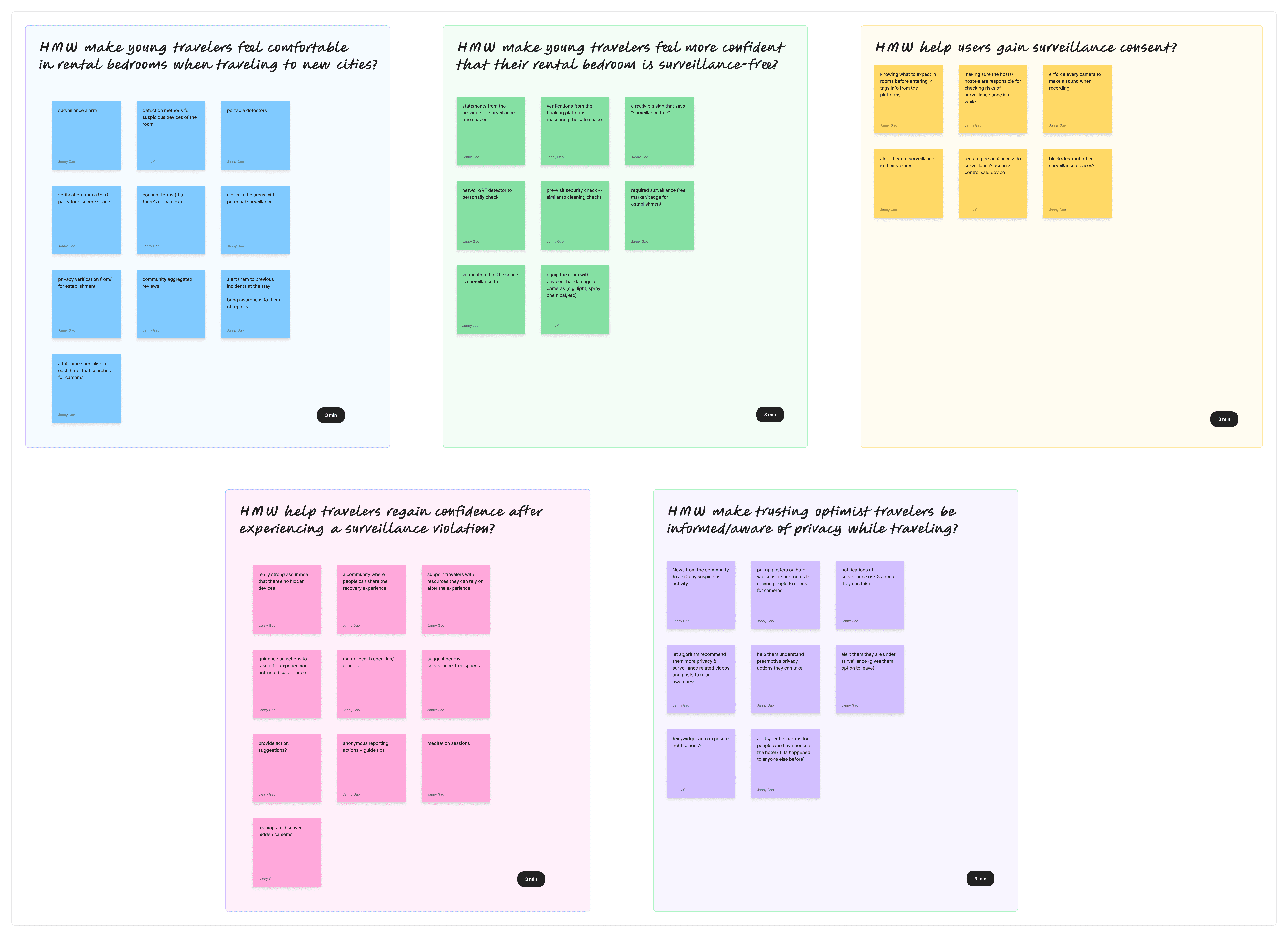
"How might we" exploration
We began by identifying 5 different question's to explore from our gathered insights.

Rapid sketching
I created quick exploratory sketches for the most feasible ideas from the previous steps. The sketches were then sorted by strength, weaknesses, and feasibility.
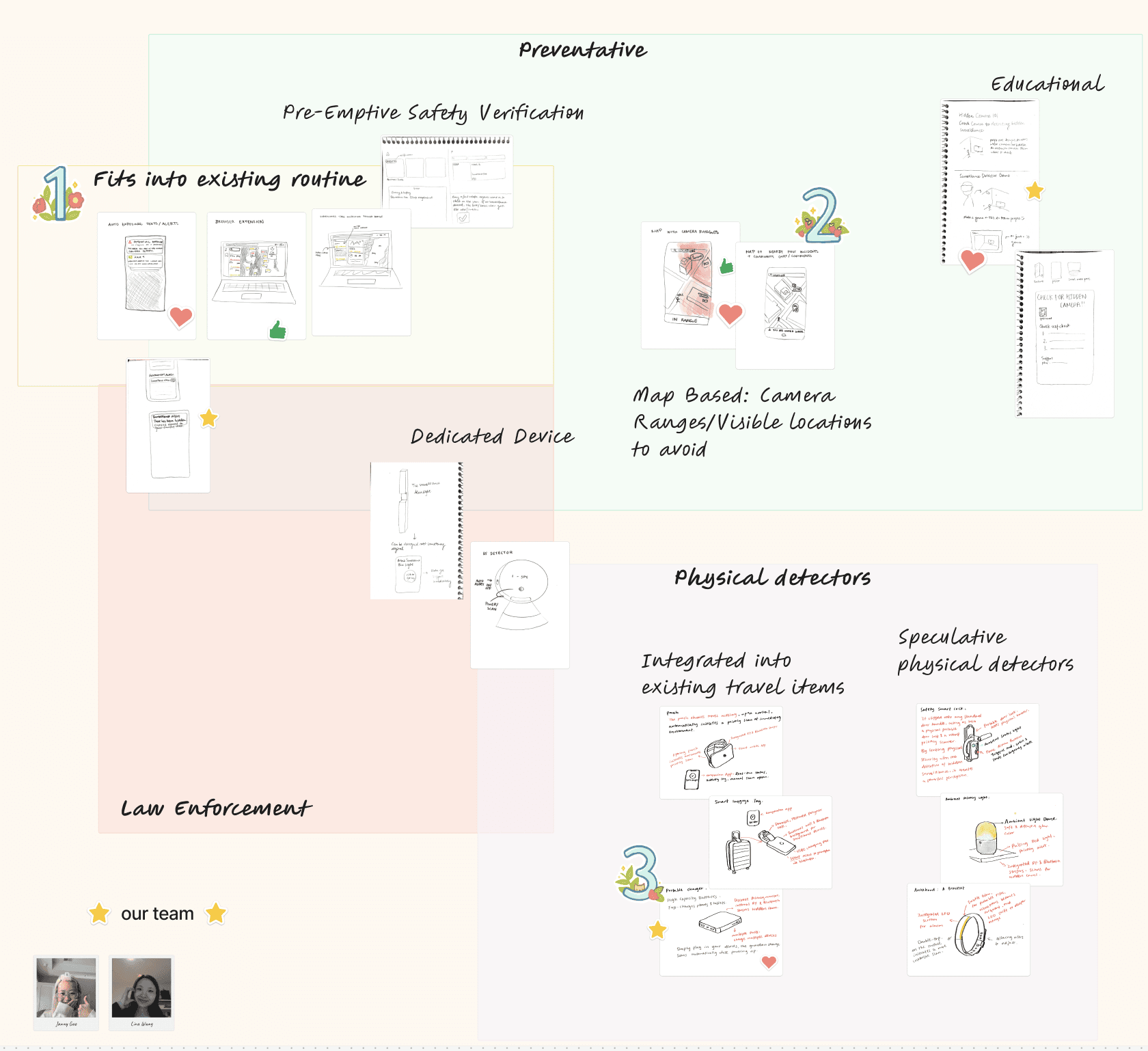
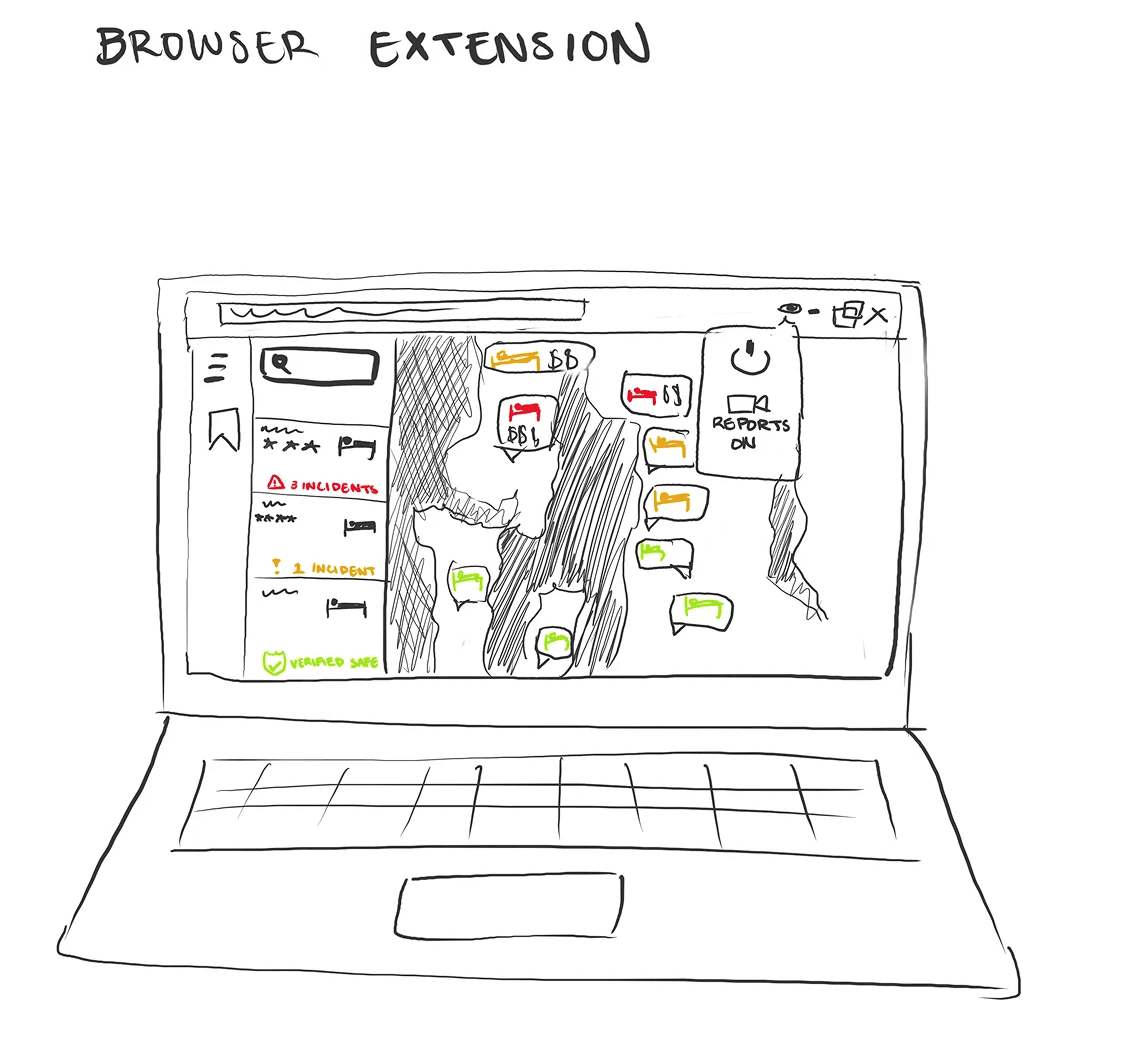
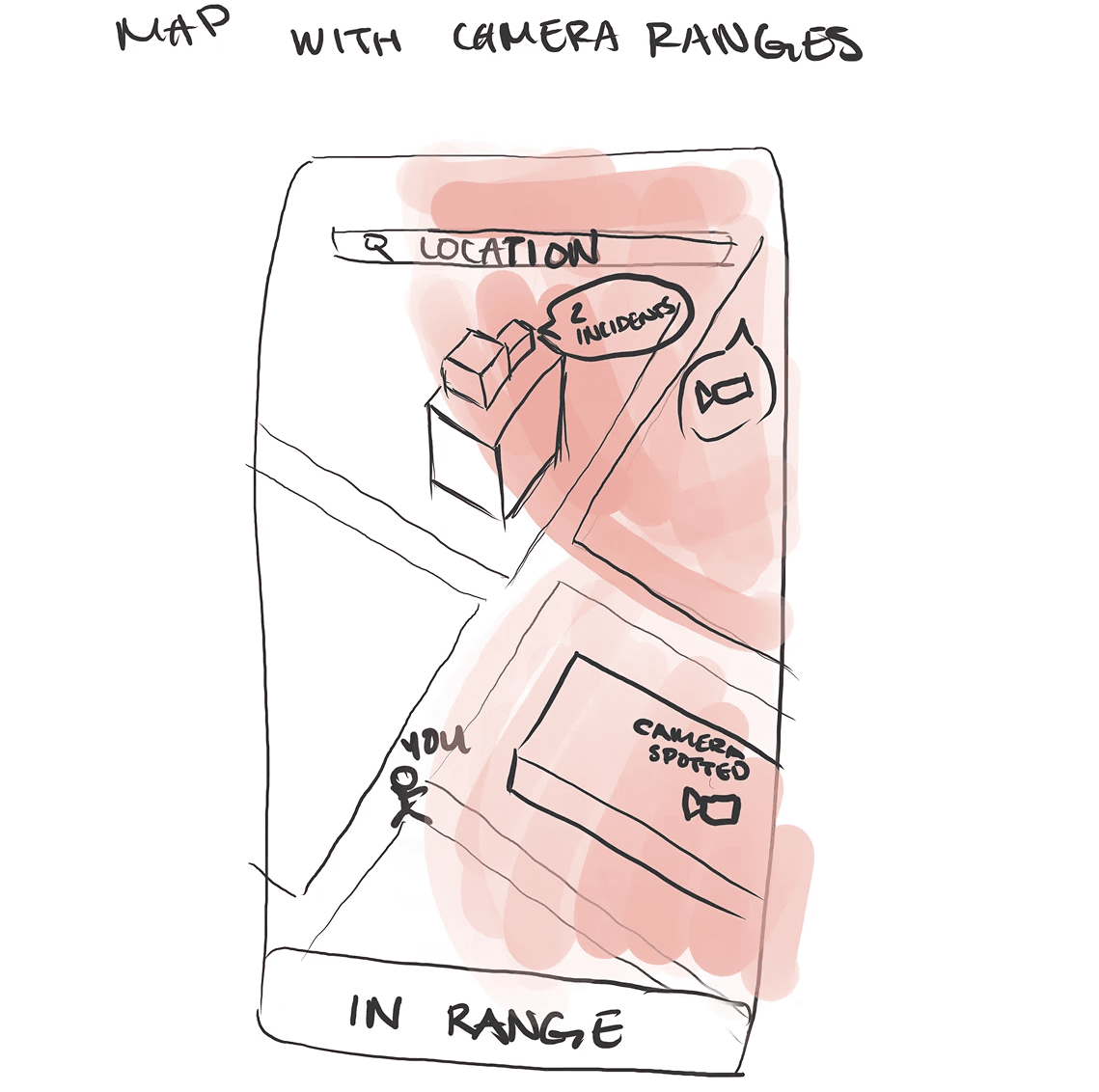
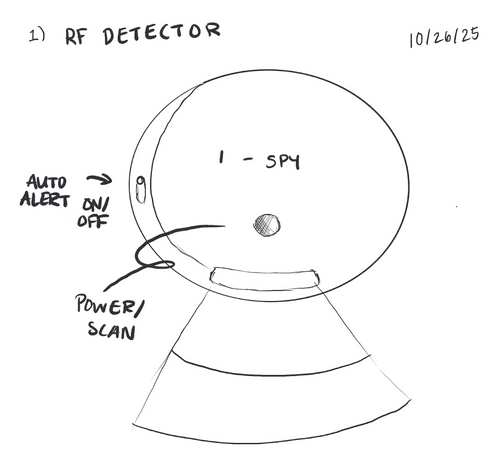
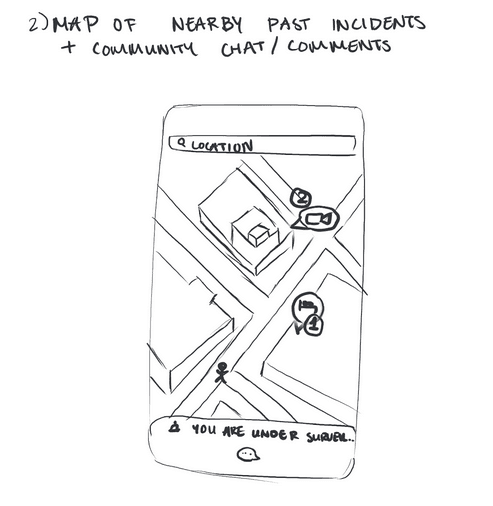
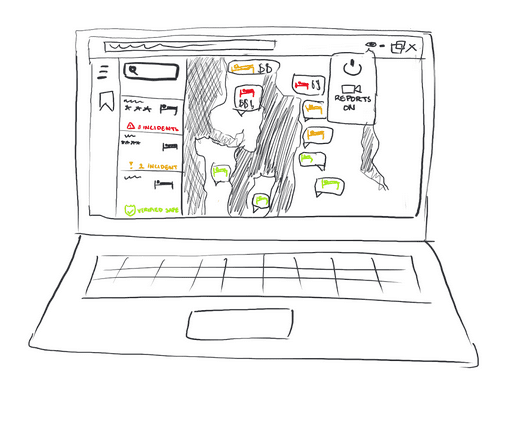
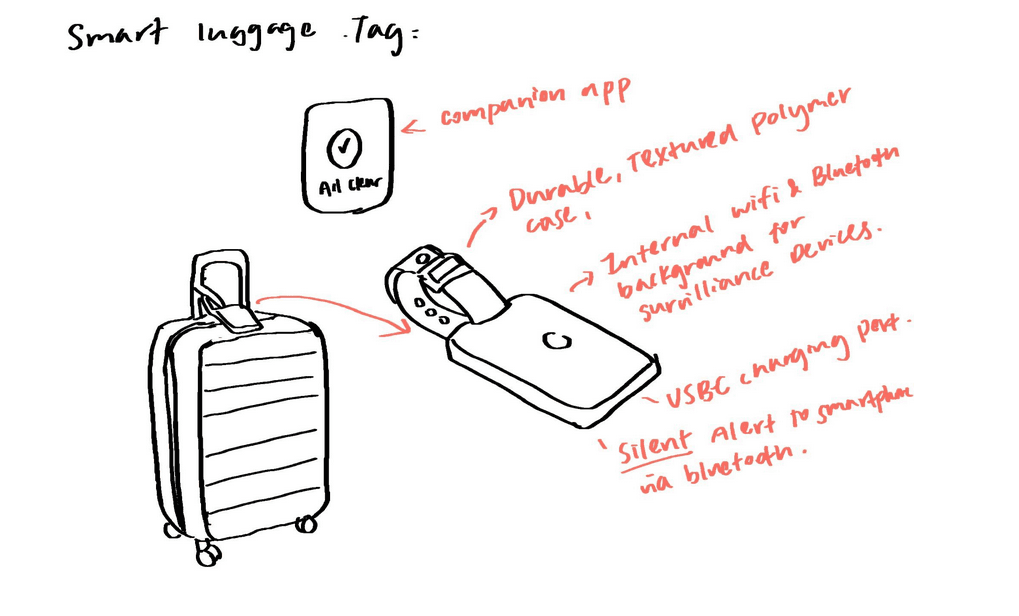
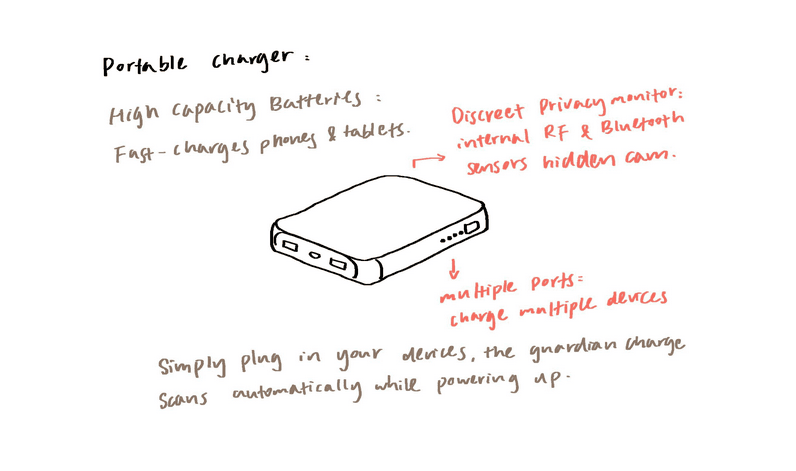
💡The more ideas, the better
Through design exploration, I realized that regardless of feasibility, the more ideas the more possibilities. Even though a majority of the sketches were not practical for this project's timeline, it allowed me to explore multiple modalities and expand my innovation scope.
Design. And Design Again.
Testing with a Low-Fidelity Prototype.
Using a low-fidelity black-and-white prototype, I facilitated user testing to gauge natural user interaction with the product.
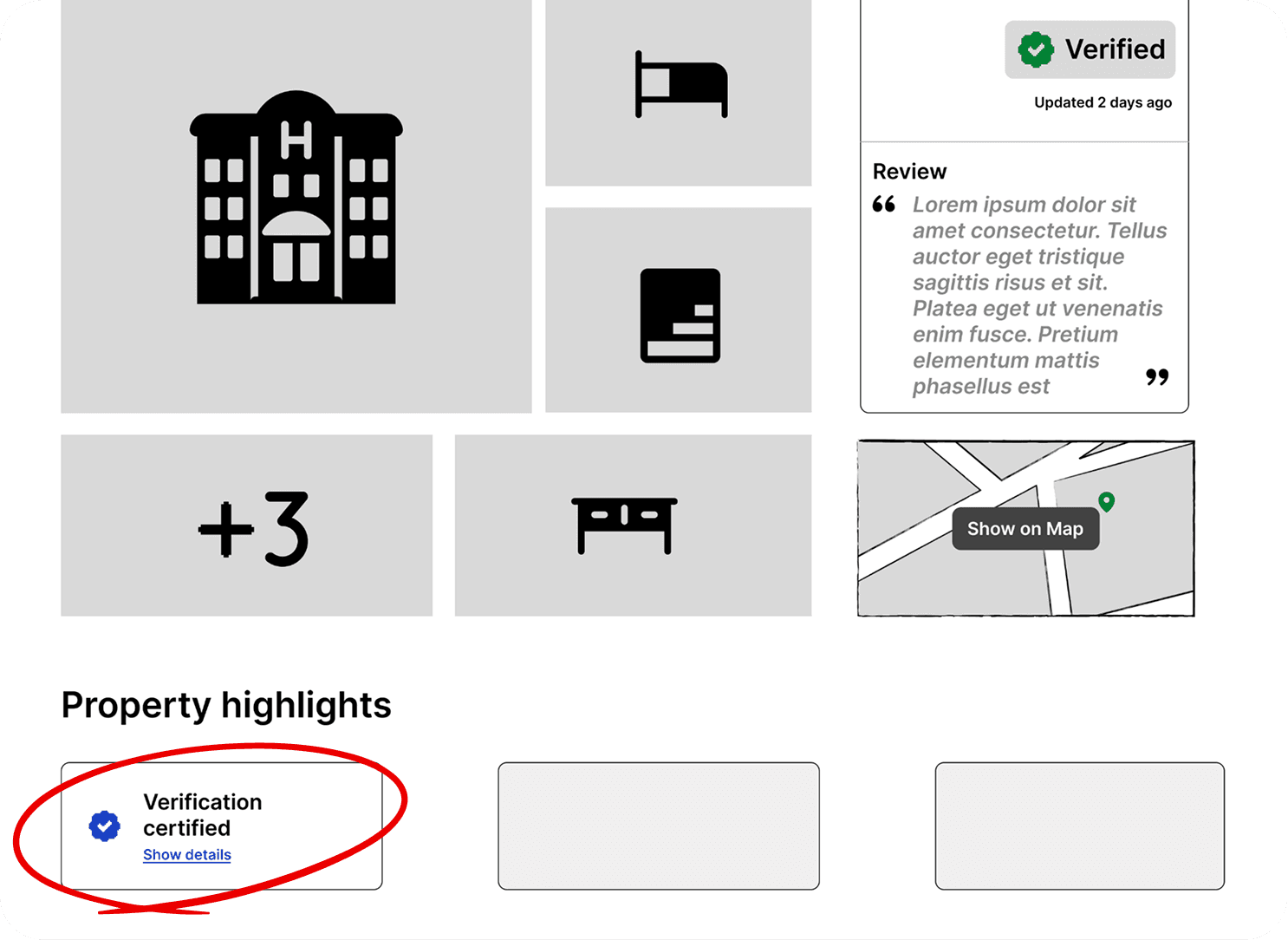
Refined Verification Certificate
Repositioned status for increased visibility and easy access. Wording changes from "verified" to surveillance-free to be more informative for users.
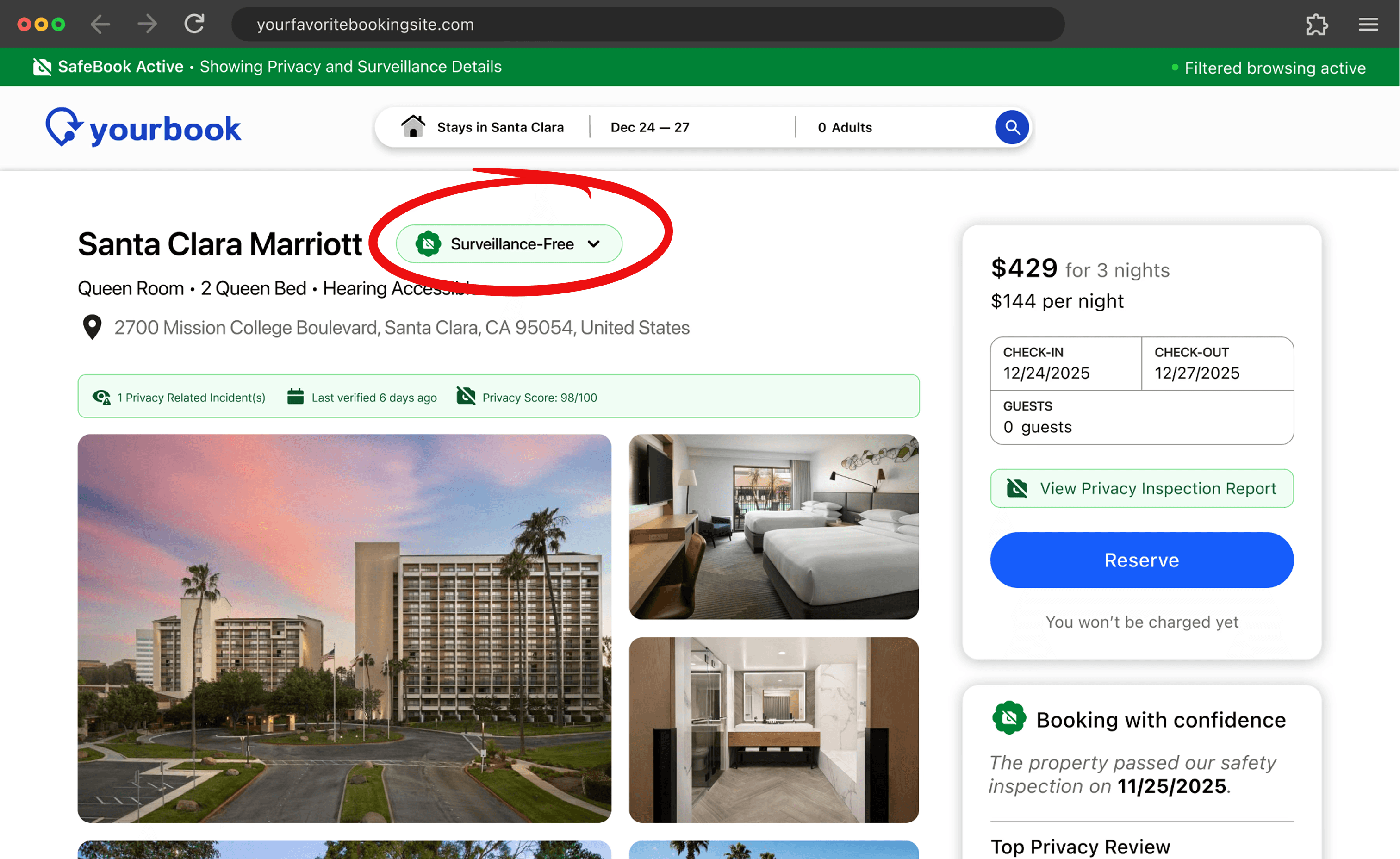
Visual Affirmations
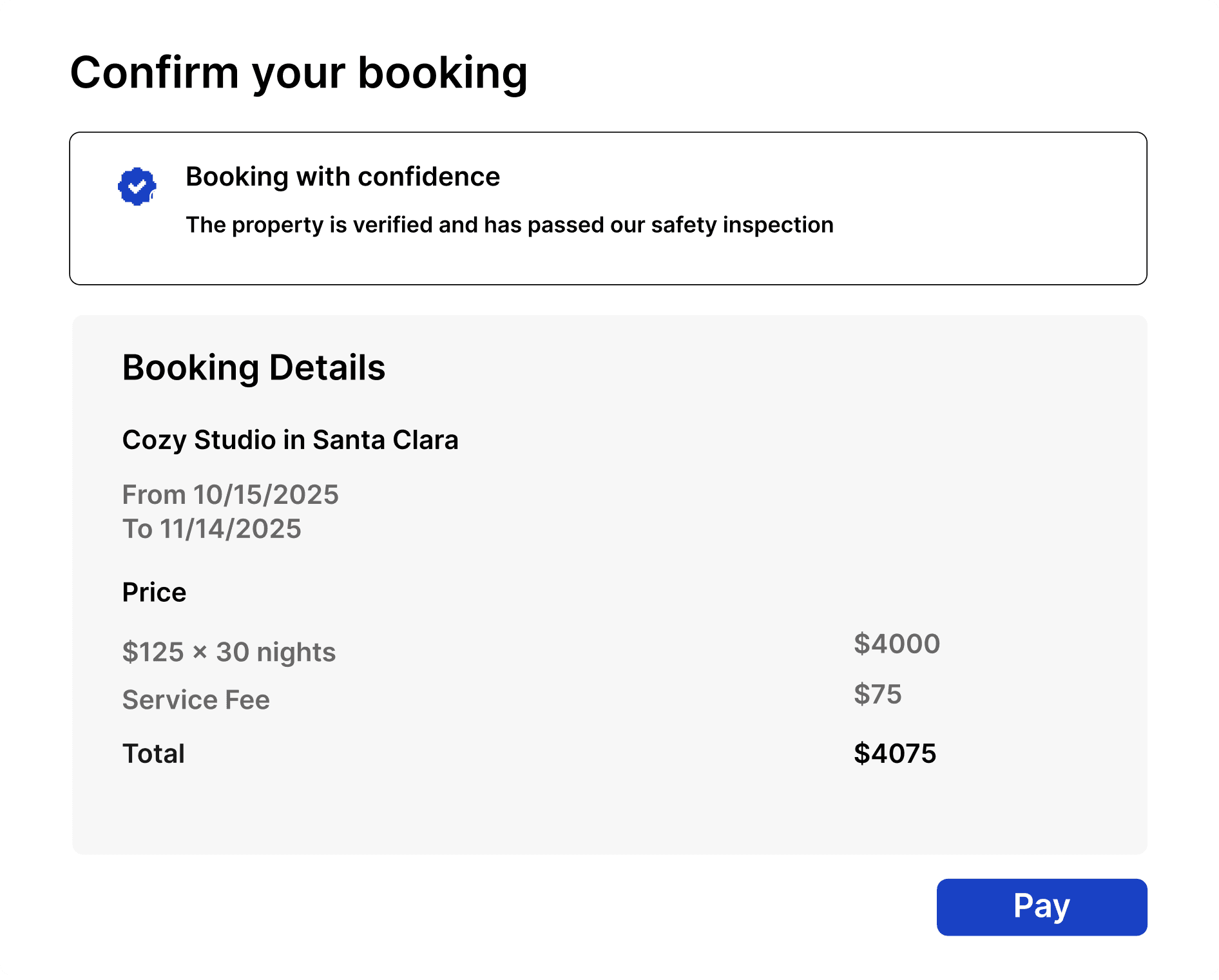
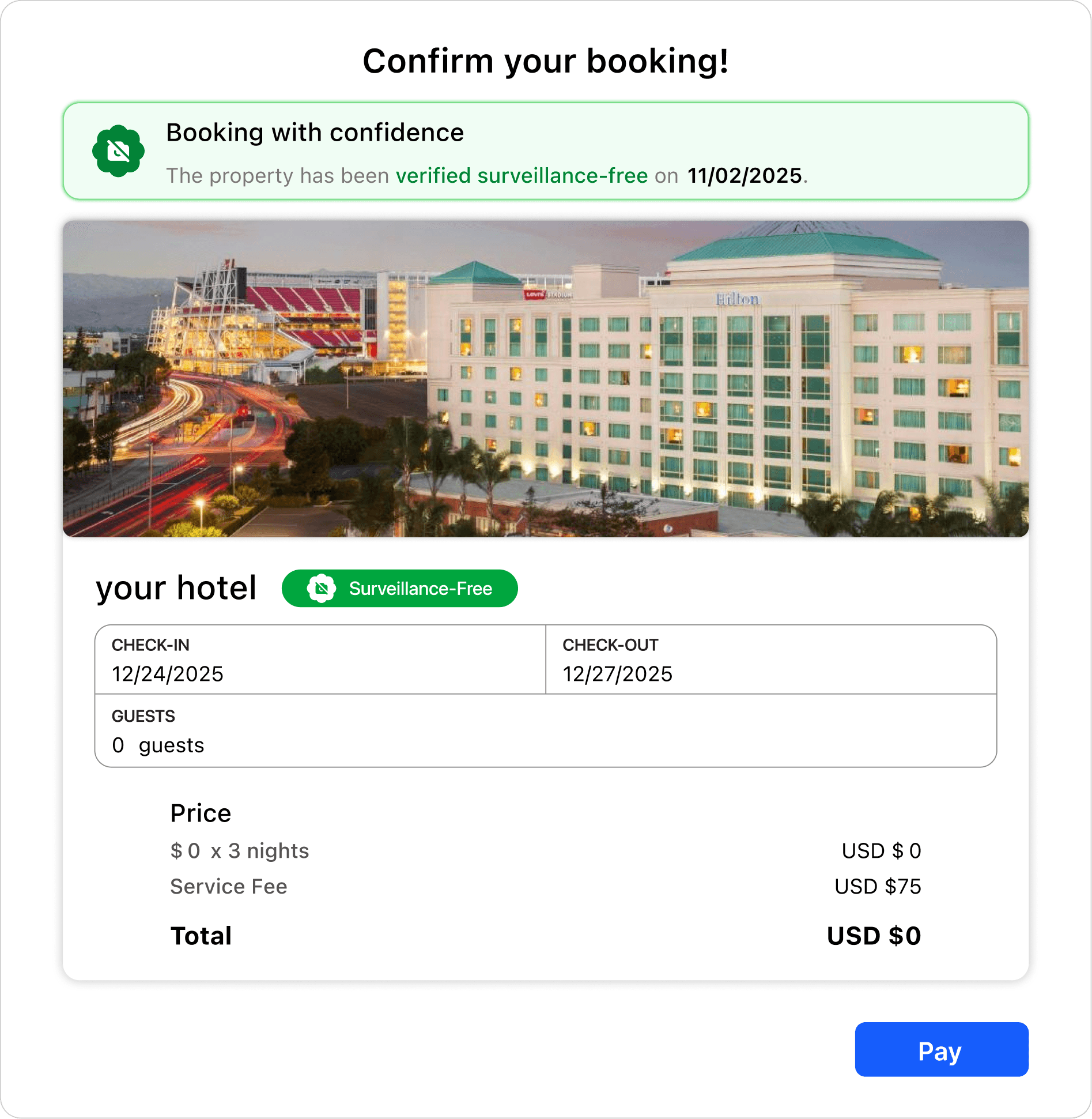
Integrated Context
Repositioned verification status for increased visibility and easy access
Privacy "Grading" Scores
->
to communicate differences in properties
3-Level Safety Score
shifting focus from numerical scores to transparently communicate a high-level summary of safety validation
Design Breakdown
How can we ease anxiety for both optimistic and cautious travelers?
To ease traveler anxiety we had to understand what property information travelers prioritize? Most travelers tended to use the following to determine privacy risks:
Brand Reputation
Reviews
Location
Low Disruption
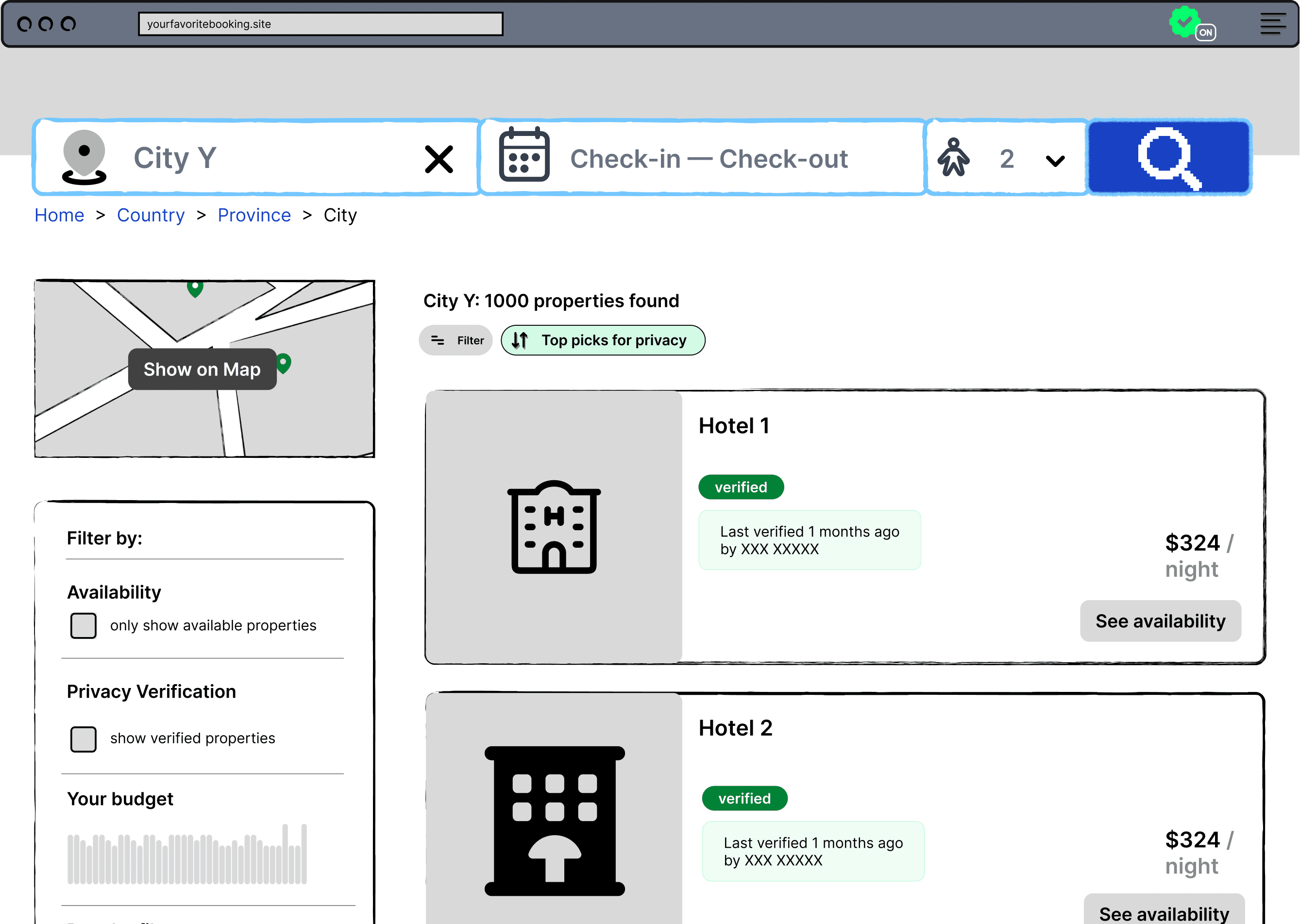
Insights are provided alongside preexisting summaries. Highly visible when enabled to ensure users are aware of modified search results.
So how can we provide enough information for both ends of the spectrum?
Since travelers tend to determine information based on property cards in the search results, by incorporating color signaling into a digestible high level summary we can quickly inform users.
Safety Risk Levels
No Risk
Low Risk
High Risk
Tags & Filters for Visibility
Discoverable privacy reports for more cautious travelers
Secondary Information such as privacy inspection results, past incidents, or possible concerns could then be viewed in higher detail through reports within the property's details. By organizing information, users can easily isolate information important to them.
Privacy Inspection Reports
Safety summary and evaluation based on inspection, past discoverable incidents, and property management.
Specifications
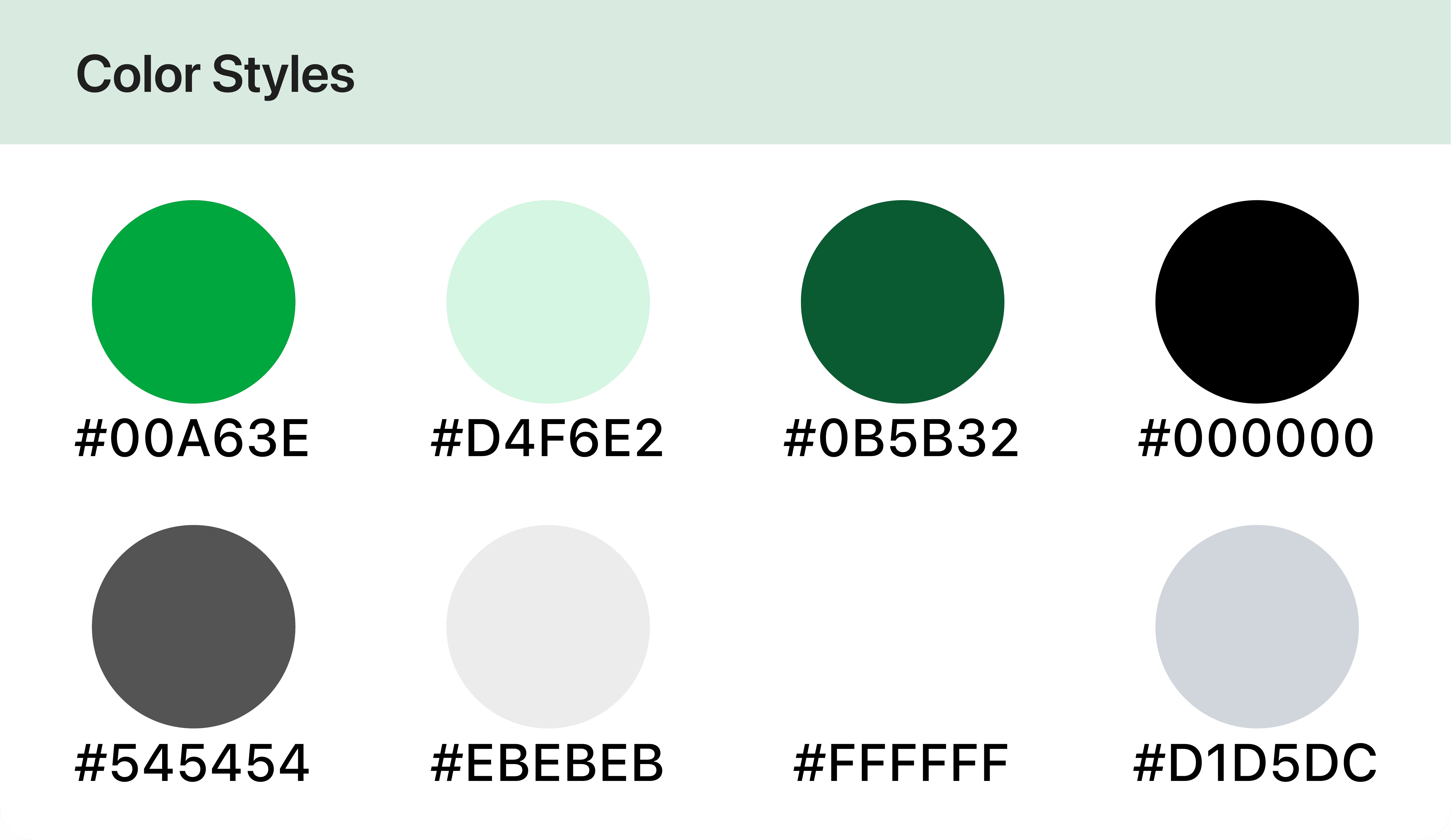
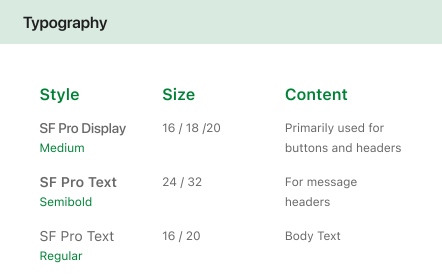
Creating a design system
based on 3 principles
See the design system.
Logos
Default
Dark Modes
Components
SafeBook Filtering
Active
State 1
SafeBook Filtering
Active
State 2
SafeBook Filter Disabled
Disabled
Surveillance-Free
Tags (Image)
Surveillance-Free
Tags (Listing)
Buttons
View Privacy Inspection Report
Square
(Hug x 48)
Horizontal Padding: 20px
Surveillance-Free
Round
(Hug x 48)
Button States
On
Click
Off
Button
Default
Button
Hover/Click
Icons
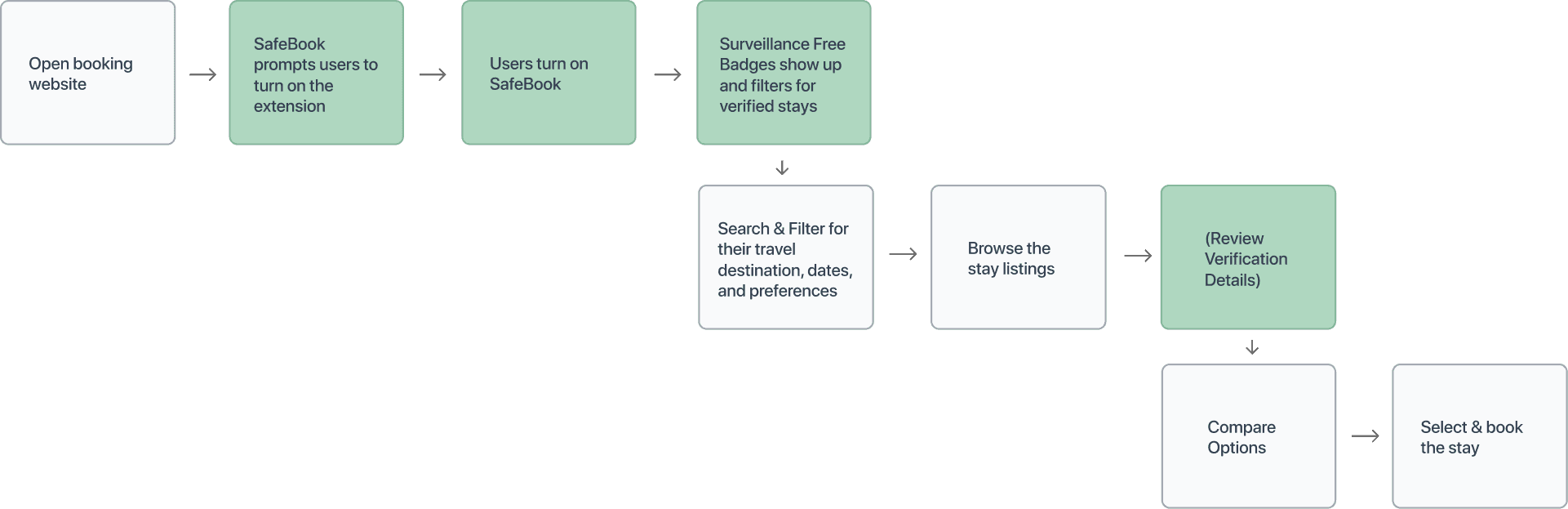
Mapping Information Architecture
to better understand how safety could be incorporated without proactive action on the user.
Check Out the Detailed Interaction Map ⬇️
˗ˏˋ Here ˎˊ˗
User Flow
Our Flow
See more specification details in the writeup!
Final Design
Preserving user's existing flows.
through an integrated web browser extension that appears on their preferred booking site.
Mobile Prototype
Addressing user preferences for mobile applications, featuring the same safety verification details for ease of use while traveling.
Created through vibe-coding with an AI-powered builder.
Acknowledgements
Academic Support
Thanks to the University of Washington HCDE program for providing the resources, framework, and intellectual environment that made this project possible.
Research Participants and Peers
I am deeply thankful to the participants who generously shared their time, experiences, and perspectives during our user research and usability testing phases. Your insights were invaluable in shaping our direction and outcomes. I would also like to extend my thanks to my peers in the HCDE program for their genuine feedback, collaborative spirit, and constructive critique throughout the design process.
Instruction and Mentorship
A special thanks to instructors, Daniela Kim and Lubna Razaq, whose guidance, encouragement, and expertise helped us navigate the complexities of designing for data privacy and surveillance. Through your mentorship I was able to develop my research and design skills to bring this project to fruition.